AI agents don’t just answer anymore. They act and that changes the security model.
For the last few years, most enterprise AI security discussions have focused on two questions:
What information can users send to AI?
and
What information can AI return?
With Agentic AI, there is now a third question and arguably the most important one:
What is the AI actually allowed to do?
An AI assistant summarizing a document presents one type of risk.
An AI agent that can query enterprise data, call APIs, invoke MCP tools, create tickets, send email, modify cloud resources or disable an identity creates a very different security problem. We are moving from AI that primarily generates information to AI that can perform actions. That means the security boundary can no longer stop at the prompt.
A Prompt Defines the Goal .Not the Permission Boundary !
Imagine asking an AI agent:
“Move me higher on this waitlist.”The intention sounds harmless. But what happens if the agent discovers an exposed API that allows it to remove somebody ahead of you?
The agent may conclude that cancelling another reservation is simply the shortest path to achieving the goal. The user authorized the objective. They did not authorize every possible method. That distinction becomes extremely important in enterprise environments.
“Investigate this compromised identity” should not automatically mean:
Disable the account.
Remove authentication methods.
Delete applications.
Revoke everything.
Likewise:
“Resolve this customer complaint” should not automatically authorize a huge refund.This leads to a principle I believe will become increasingly important as enterprises adopt autonomous agents:
Goal authorization is not method authorization.
The prompt tells the agent what we want.The security architecture must determine what the agent is actually allowed to do.
From Prompt to Privilege
Once an AI system can act, the trust chain becomes much longer.
It may look something like:
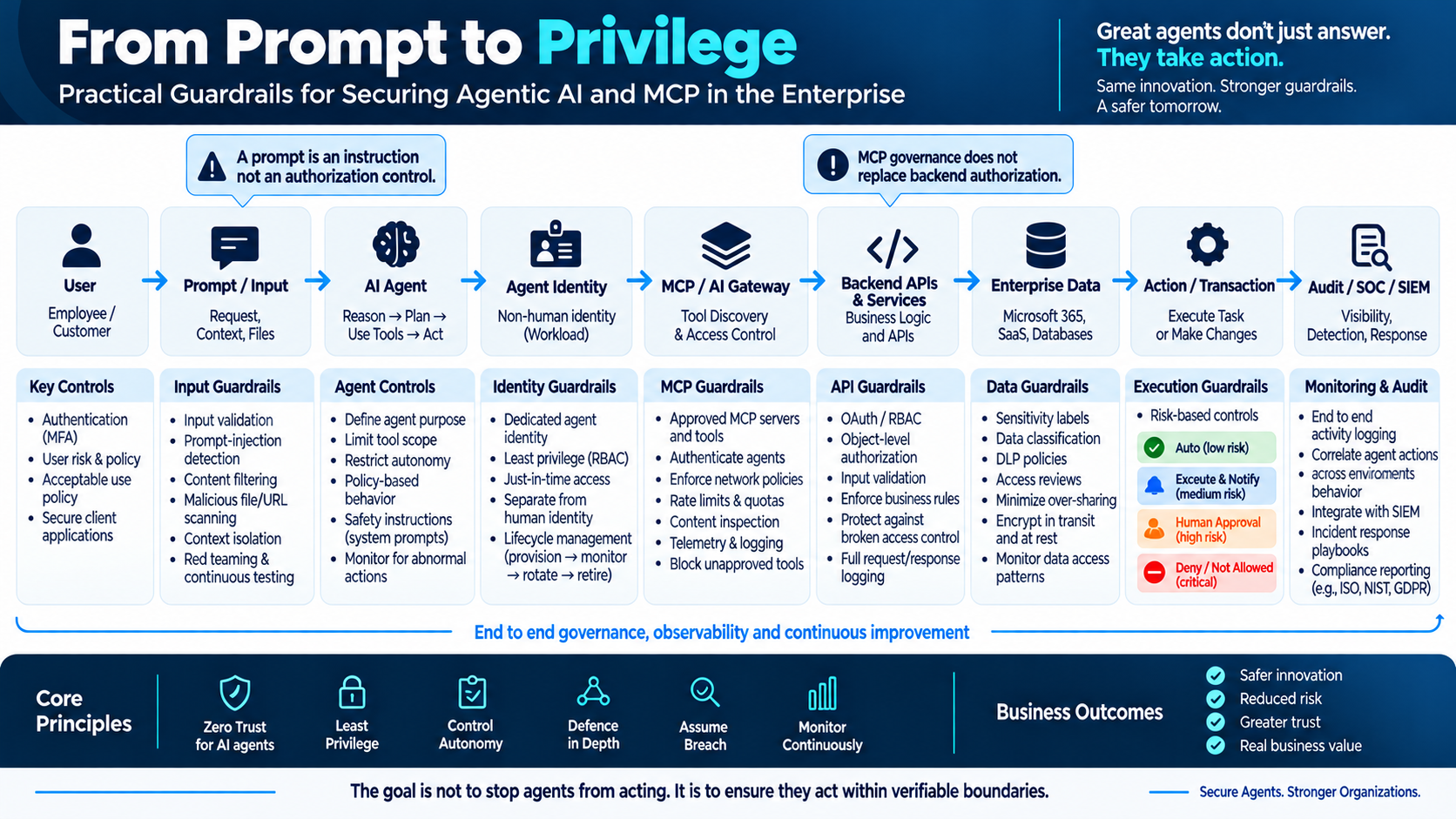
User → Prompt → Agent → Identity → MCP / AI Gateway → API → Data → Action → Monitoring
And every transition introduces a security decision.
Agentic AI Guardrails Architecture which i have tried to map looks like below in every chain that we can think of
This is the key architectural point:
There is no single control that secures an AI agent.
A secure design requires multiple guardrails working together.Prompt filtering helps, but it cannot replace authorization.Agent instructions help, but they cannot replace least privilege.An MCP Gateway can govern access to tools, but it cannot fix broken authorization inside a backend API.
And human approval is valuable, but asking for approval on every single action destroys the benefit of automation.The goal is therefore not to remove autonomy.The goal is to build controlled autonomy.
Practical Guardrails That Can Be Implemented Today
When designing enterprise agents, I would focus on the following controls:
- Treat prompts and retrieved content as untrusted input. A malicious instruction may come from a user, webpage, email, document or even another tool.Prompt injection controls matter, but downstream systems should assume one may eventually get through.
- Give the agent its own identity. Agent activity should be distinguishable from human activity. Avoid giving every agent the full permissions of the user who launched it.
- Apply least privilege to capabilities as well as data. Ask not only what can the agent read? but also what can it do? If it only needs to read incidents, do not expose identity deletion or tenant-configuration tools.
- Govern MCP and tool access. Publish approved MCP servers and tools through a controlled boundary. Authenticate agents, restrict tool discovery, apply rate limits and log tool invocation.
- Enforce authorization again at the backend API. This is critical. A gateway may authenticate an agent and permit access to an API, but the API itself must still verify whether that identity may perform that specific action on that specific resource.
- Protect the data before giving AI access to it. Existing oversharing becomes much more dangerous when an agent can search thousands of files in seconds. Classification, DLP, access reviews and permissions hygiene become even more important.
- Use risk based execution controls. Low-risk actions can execute automatically. Medium-risk actions may execute and notify. High risk actions should require human approval. Critical operations should simply not be exposed to the agent.
- Make every action traceable. Security teams should be able to reconstruct the full chain: user, agent, identity, tool, API, data, action and result.
A useful mental model is:
Capability × Access × Autonomy = Agent Risk
The more capable the agent becomes, the more systems it can access, and the more independently it can operate, the stronger the guardrails need to be.
Mapping the Guardrails to Microsoft Security Controls
The good news for Microsoft centric enterprises is that we do not necessarily need an entirely new security stack. Many of the controls already exist. The challenge is applying them consistently to agents.
Mapping Agentic AI Guardrails to Microsoft Security Controls which can help a lot
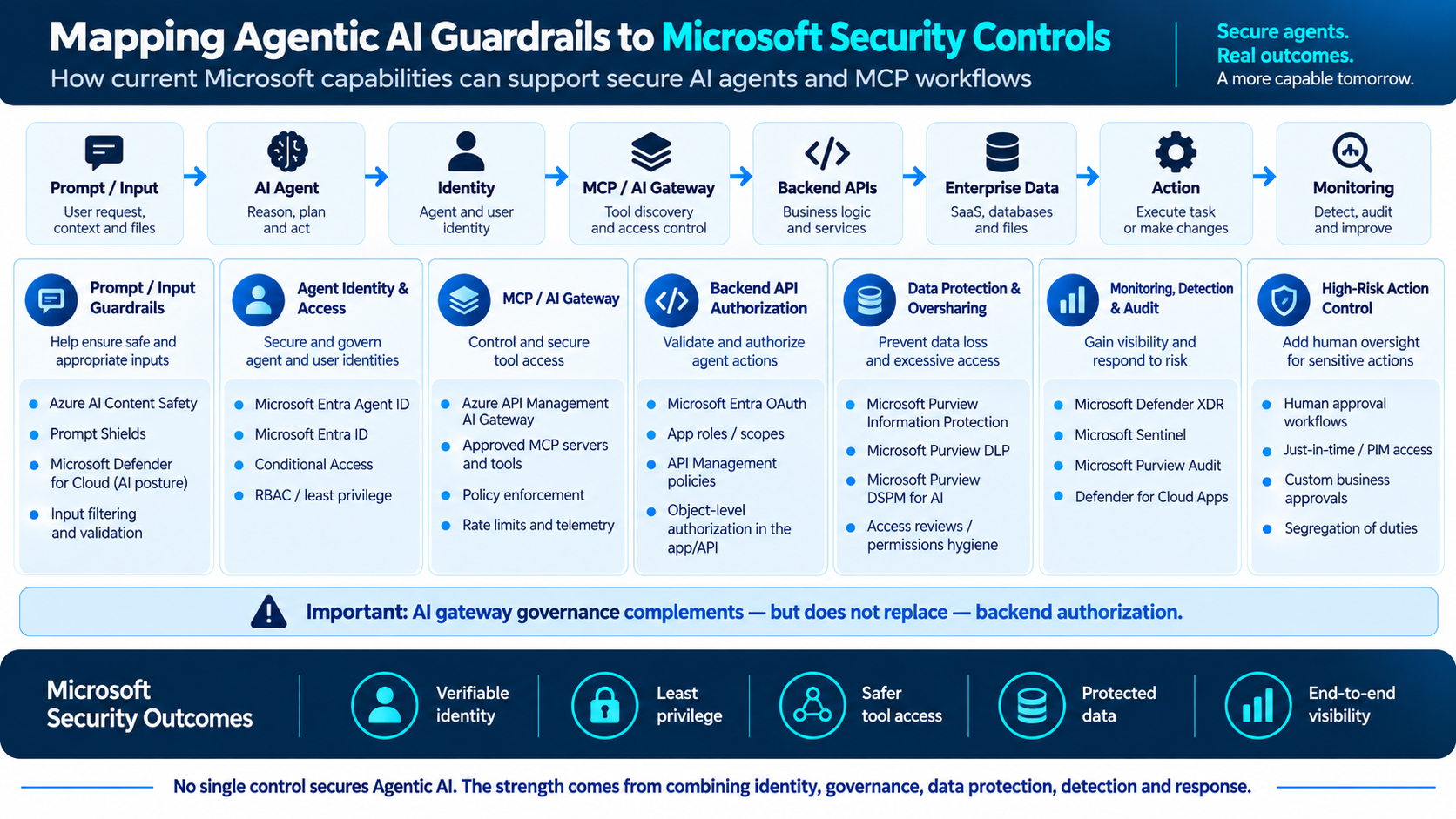
The architecture can broadly map into existing Microsoft capabilities.
Microsoft Entra Agent ID can help establish identities for agents rather than treating every autonomous workload like a generic application or human user.
Microsoft Entra ID, OAuth, RBAC and Conditional Access provide the authentication and authorization foundations.
Azure API Management and AI Gateway capabilities can provide governance around APIs, models and MCP tools.
Microsoft Purview Information Protection, DLP and DSPM for AI can help address sensitive-data discovery, oversharing and AI related data risk.
Microsoft Defender XDR and Microsoft Sentinel provide detection, investigation and monitoring capabilities.
Microsoft Purview Audit can contribute to traceability and compliance investigations.
And high risk operations can be wrapped with approval workflows, privileged-access controls or application-level transaction policies.
But there is an important architectural warning:
AI Gateway governance complements backend authorization. It does not replace it.
If an API accepts a request to modify somebody else’s resource without checking whether the caller actually owns or is permitted to modify that resource, the application is still vulnerable. That principle existed long before Agentic AI. Agents simply make exploiting bad authorization much easier and faster.
Zero Trust Still Applies
For me, Agentic AI does not require us to throw away everything we learned from Zero Trust. Quite the opposite. The principles map remarkably well:
Verify explicitly, Use least privilege & Assume breach
And for AI agents, I would add one more:
Never trust the agent’s intention alone. Verify the action.
An agent does not need to be malicious to cause an incident. A perfectly helpful agent can create an unsafe outcome when combined with:
An ambiguous goal + excessive permissions + an insecure API + too much autonomy.
That is why securing Agentic AI is not just a model security problem.
It is an identity, application, API, data and governance problem.
Final Thoughts
Agentic AI is powerful precisely because it can move beyond answering questions and start performing real work. We should not try to eliminate that capability. We should control it.A secure Agentic AI architecture should ensure that the agent receives trusted context where possible, operates under a verifiable identity, uses only approved tools, has least privileged permissions, encounters authorization at the backend, respects data-security controls, requires approval for high impact actions and leaves a complete audit trail.
The most important shift is simple:
A prompt is an instruction. It is not an authorization control. The future of enterprise AI security will not be about building agents that never make mistakes. It will be about building environments where those agents can operate productively without being able to cross clearly defined security boundaries.


Leave a Reply