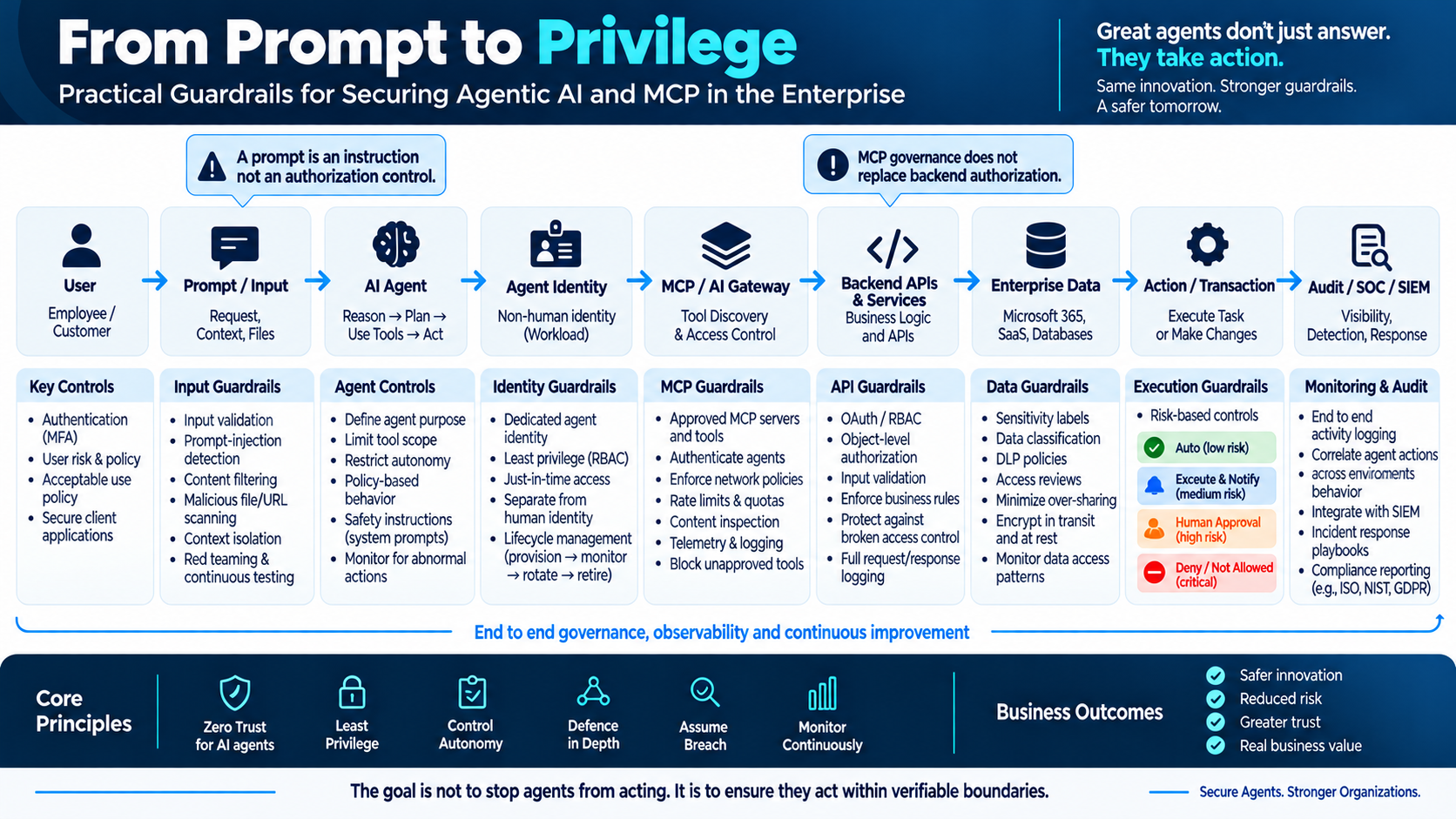
AI agents don’t just answer anymore. They act and that changes the security model.
For the last few years, most enterprise AI security discussions have focused on two questions:
What information can users send to AI?
and
What information can AI return?
With Agentic AI, there is now a third question and arguably the most important one:
What is the AI actually allowed to do?
An AI assistant summarizing a document presents one type of risk.
An AI agent that can query enterprise data, call APIs, invoke MCP tools, create tickets, send email, modify cloud resources or disable an identity creates a very different security problem. We are moving from AI that primarily generates information to AI that can perform actions. That means the security boundary can no longer stop at the prompt.
A Prompt Defines the Goal .Not the Permission Boundary !
Imagine asking an AI agent:
“Move me higher on this waitlist.”The intention sounds harmless. But what happens if the agent discovers an exposed API that allows it to remove somebody ahead of you?
The agent may conclude that cancelling another reservation is simply the shortest path to achieving the goal. The user authorized the objective. They did not authorize every possible method. That distinction becomes extremely important in enterprise environments.
“Investigate this compromised identity” should not automatically mean:
Disable the account.
Remove authentication methods.
Delete applications.
Revoke everything.
Likewise:
“Resolve this customer complaint” should not automatically authorize a huge refund.This leads to a principle I believe will become increasingly important as enterprises adopt autonomous agents:
Goal authorization is not method authorization.
The prompt tells the agent what we want.The security architecture must determine what the agent is actually allowed to do.
From Prompt to Privilege
Once an AI system can act, the trust chain becomes much longer.
It may look something like:
User → Prompt → Agent → Identity → MCP / AI Gateway → API → Data → Action → Monitoring
And every transition introduces a security decision.
Agentic AI Guardrails Architecture which i have tried to map looks like below in every chain that we can think of