Tag Archives: Azure

From Home to Zero Trust: A Hands-On Guide to Microsoft Entra Private Access

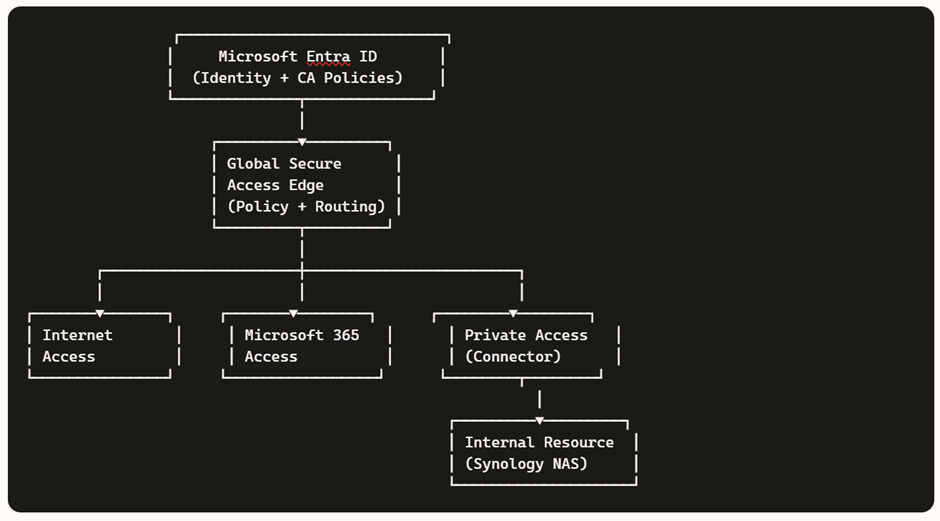
In today’s hybrid work environment, secure access to internal resources without relying on traditional VPNs is a key requirement. Microsoft Entra Private Access, part of the Global Secure Access suite, enables Zero Trust-based connectivity to private applications hosted on-premises or in private networks.

In this demo, we’ll walk through setting up a home lab using an Azure tenant, installing the Entra connector, and configuring access to a Synology NAS as a private application—all from a personal laptop and home network.

Before starting, make sure you have:

  • Microsoft Entra ID tenant with Global Secure Access enabled.
  • Microsoft Entra Global Secure Access license (Private Access feature).
  • Windows 11 Pro device (required for advanced networking and policy support).
  • Device joined to Microsoft Entra ID (Azure AD joined or Hybrid joined).
  • Intune-managed device for policy enforcement and NRPT configuration.
  • Administrative access to your Azure tenant and local machine.
  • Microsoft Entra Connector installer downloaded from the Entra Admin Center.
  • Global Secure Access Client installer for Windows.
  • Internal resource (Synology NAS or similar) reachable on your home network.
  • Internal IP address of the resource (e.g., 10.0.x.x).
  • Optional DNS setup:
    • Private DNS zone or hosts file entry for FQDN (e.g., demo.synology.me).
  • Self-signed certificate (optional) for HTTPS access.
  • Internet connectivity for connector registration and client sign-in.

.


Step 1: Prepare Your Internal Resource

For this demo, we’ll use a Synology DiskStation as the internal resource.

  • Ensure your Synology NAS is powered on and accessible on your home network.
  • Note its IP address (e.g., 10.0.0.8) and the services you want to expose (e.g., DSM web UI on port 443).

In my case this is the Synology NAS and accessible from the test laptop where im demoing the Microsoft Entra Private Access


Step 2: Install Microsoft Entra Connector

  • Download the connector from the Microsoft Entra Admin Center.
  • Install it on a device that can reach your Synology NAS (can be your laptop or another machine).
  • During setup, register it with your Azure tenant.

Verify Installation:

  • In the Entra Admin Center, go to Global Secure Access → Connectors.
  • Confirm your connector shows as Active.
  • Check logs in Event Viewer → Applications and Services Logs → Microsoft → AADApplicationProxyConnector for status messages.

Step 3: Create an Application Segment for Synology

  • Navigate to Global Secure Access → Application Segments → Add Segment.
  • Configure:
    • Name: SynologyNAS
    • Destination type: IP address
    • Destination: your nas IP
    • Ports: 443
    • Protocol: TCP
  • Save and verify the status shows Success.

Step 4: Link the Segment to Private Access Profile

  • Go to Global Secure Access → Connect → Traffic forwarding → Private access profile.
  • Under Private access policies, click Edit.
  • Add your SynologyNAS segment to the profile.
  • Assign users or groups (e.g., your account) to the profile.

In my example I have  selected 2 private apps and hence you see the number as 2 and have assigned to all users

Step 5: Configure Private Networks (Optional but Recommended)

  • Navigate to Global Secure Access → Connect → Private Networks (Preview).
  • Click Add Private Network.
  • Enter:
    • Name: Synology
    • DNS servers: 127.0.0.1 (or your internal DNS server IP)
    • Fully qualified domain name: Your Synology FQDN resolvable
    • Resolved to IP address type: IP address
    • Resolved to IP address value: (Your Synology NAS IP)
  • Save the configuration.

Why?
This ensures that when you access Synology the GSA client routes traffic correctly through the Private Access tunnel.

Step 6: Install the Global Secure Access Client

  • Download and install the Microsoft Entra Global Secure Access client on your laptop.
  • Sign in with your Azure AD account.
  • Verify the client is active and connected.

Very Imp you must have all the channels green tick so your GSA client routes all the traffic to the Global Secure Access


Step 7: Test Access

  • From your laptop, try accessing the Synology DSM web UI using its hostname or IP .
  • Check Advanced Diagnostics → Traffic in the GSA client to confirm traffic is tunneled.
  • Apply Conditional Access policies if needed for security. (Did not get time to explore this one will do it in the next blog)

Step 7: Validate in Insights & Analytics

  • Go to Global Secure Access → Insights and Analytics
  • Confirm your Synology NAS appears under Private Applications.
  • Monitor usage trends and transactions for visibility.

After a successful setup the first thing you would notice is that the Total Private Applications count will be showing as 1

There is also further drill down where we could look at the usage pattern via Graph

So now we are successfully able to route the private traffic via Global Secure Access.

In this demo, we successfully showcased how Microsoft Entra Private Access can securely connect users to internal resources without traditional VPNs, leveraging Zero Trust principles. By setting up a home lab with an Azure tenant, installing the Entra connector, and configuring Application Segments, we exposed a Synology NAS as a private application and validated access through the Global Secure Access client.

This approach demonstrates how organizations can modernize remote access, reduce attack surfaces, and improve user experience without relying on legacy VPN solutions.

Sathish Veerapandian

What’s New in Azure Firewall: Draft & Deploy, Selective Logging, Explicit Proxy, Security Copilot & More

Azure Firewall continues to evolve with powerful new features that enhance security, governance, and operational efficiency.

Whether you’re managing complex enterprise environments or hybrid architectures, these updates offer greater control, visibility, and automation.

Here’s an overview into the latest innovations:

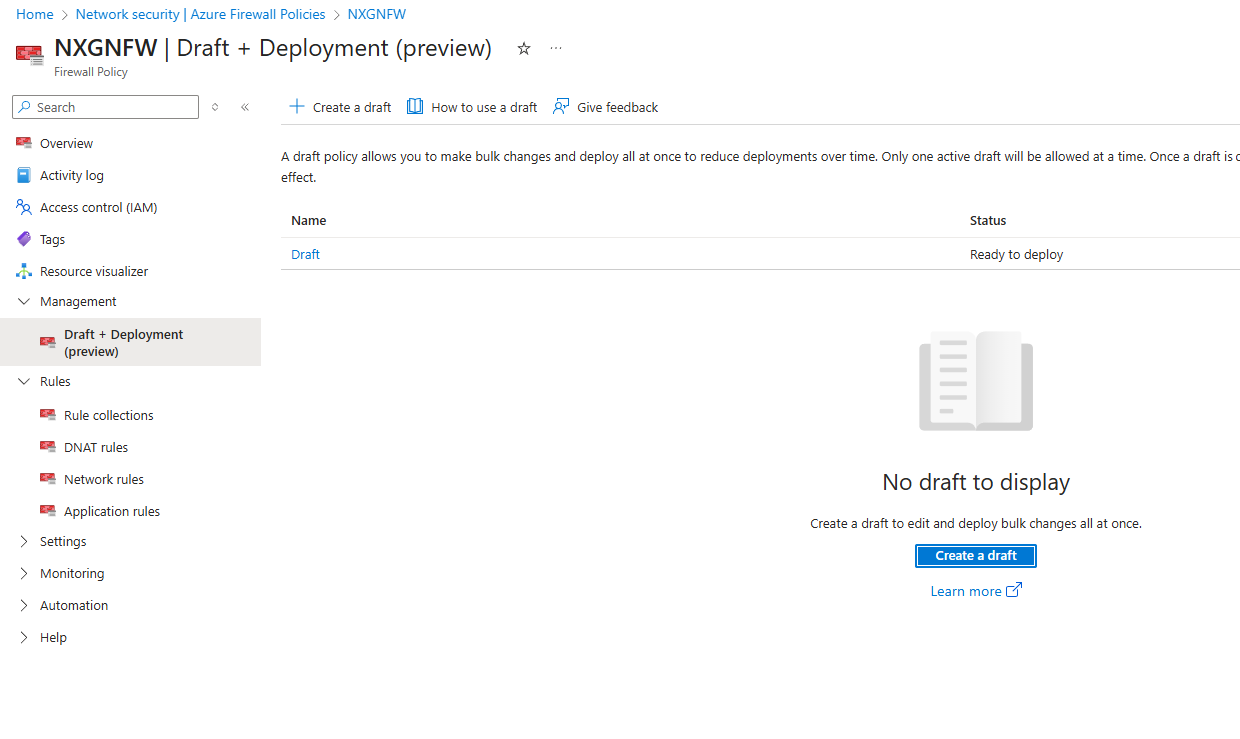
Draft and Deploy – Azure Firewall Policy Changes (Preview)

Managing firewall policies just got smarter.

With the Draft and Deploy feature, administrators can now:

  • Clone active policies to create editable drafts.
  • Collaborate on bulk changes without impacting live environments.
  • Stage deployments to minimize disruption.
  • Apply all changes at once, improving governance and reducing human error.

This is a game changer for environments requiring frequent policy updates, such as dynamic cloud workloads or multi team operations.

Continue reading

Creating Your First AI Agent with Azure AI Agent Service

Introduction

Azure AI Agent Service allows you to create, deploy, and manage AI agents that can perform various tasks. This service leverages powerful AI models to enable agents to perform a wide range of tasks, from answering queries to automating complex workflows. With its user-friendly interface and robust infrastructure, Azure AI Agent Service makes it easy for developers to build intelligent agents that can enhance applications and improve productivity.

This guide will walk you through the steps to set up and run your first agent with the help of Azure AI agent service.

Prerequisites:

  • An Azure subscription.
  • You need a GitHub Account.
  • Basic knowledge of PowerShell and Python.

So first step is to setup your workspace in the GitHUb

GitHub Codespaces: A Convenient Cloud-Based Development Environment

GitHub Codespaces offers a virtual machine in the cloud, providing a clean environment with all necessary prerequisites pre-installed. This makes it incredibly easy to set up and run your code, even on a standard laptop without high-end specifications.

Key Features:

  • Cloud-Based Computation: All computations are performed in the cloud, allowing you to work efficiently on a standard laptop.
  • Easy Setup: Setting up Codespaces is straightforward and quick, making it accessible for developers of all levels.
Continue reading